
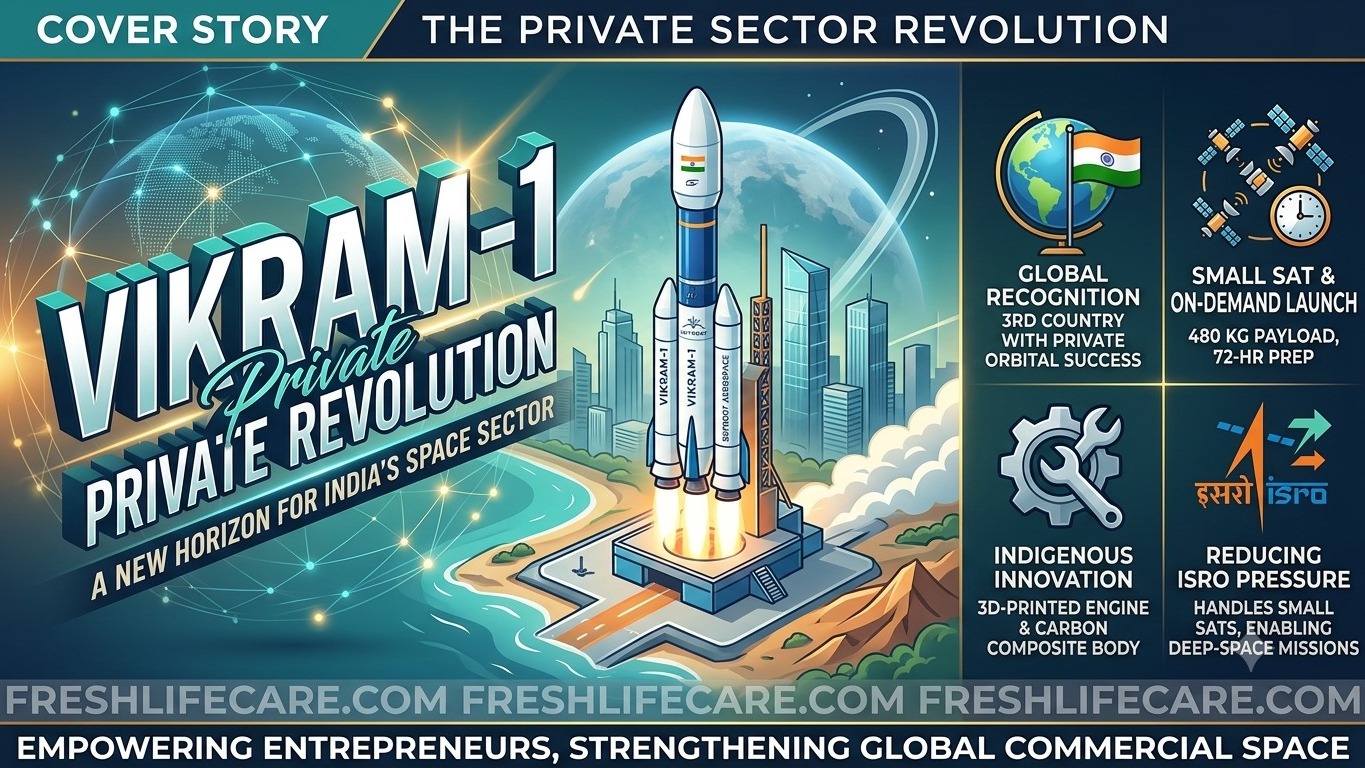
Vikram-1: A New Horizon in Indian Space Science and the Private Sector Revolution
India's space research sector has achieved unprecedented success over the past few decades. Previously, where the government agency ISRO (Indian Space Research Organisation) single-handedly led the nation's space expeditions, the central government's policy of privatizing the space sector has given rise to multiple promising startups. The most pioneering name in this trend is the Hyderabad-based Skyroot Aerospace. Their flagship orbital rocket, 'Vikram-1', has marked a new chapter in India's private space industry.
The rocket is named 'Vikram-1' as a tribute to the father of the Indian space program, Dr. Vikram Sarabhai.
1. Rocket Structure and Technical Features
Vikram-1 is primarily a Small-lift Launch Vehicle, specially designed to deliver small and medium-sized artificial satellites into Low Earth Orbit (LEO).
4-Stage Propulsion System:
First Three Stages: Based on solid fuel. These stages help the rocket quickly pierce the atmosphere and ascend.
Fourth or Final Stage (Raman Engine): This is a liquid fuel-based Reaction Control System. It helps to precisely place artificial satellites into orbit.
Carbon Fiber Body: Advanced carbon composite materials have been used to build the rocket's main framework or casing. It is manufactured using automated 'filament winding' technology, which makes the rocket much lighter than a metallic structure yet extremely strong.
3D Printed Technology: Many critical components of the rocket's liquid engine are manufactured using in-house 3D printing technology, which reduces both production time and cost manifold.
2. Payload Capacity and Performance
There is a huge global demand for launching small satellites or nano-satellites. The Vikram-1 rocket has been designed targeting that demand:
Maximum Carrying Capacity (LEO): Approximately 480 kg (into Low Earth Orbit).
Polar Orbit Capacity (SSPO): Approximately 290–300 kg (into a 500 km Sun-Synchronous Polar Orbit).
Launch Center: Satish Dhawan Space Centre (SDSC-SHAR), Sriharikota.
3. Commercial Importance and Market Potential
Until now, small satellite manufacturers had to wait for a long time to launch as a "rideshare" with the main payload of a large rocket. Vikram-1 has brought a solution to this problem:
On-Demand Launch: The rocket is extremely easy to transport from one place to another and can be assembled in a very short time. It can be made ready for launch within just 72 hours of preparation.
Affordable Pricing: Despite using world-class technology, it provides launch services at a much lower cost compared to other international private rockets.
Multi-Satellite Dispenser: It features the capability to deploy multiple artificial satellites into different orbits in a single mission.
4. Impact on India's Private Space Sector
In November 2022, Skyroot made history by successfully testing their 'Vikram-S' sub-orbital rocket. Continuing that momentum, the Vikram-1 rocket is helping position India as a major hub in the global space market.
In the era of global commercial giants like SpaceX, Skyroot's initiative proves that young Indian innovators are fully capable of building world-class aerospace technology.
The successful launch of Vikram-1 into space has brought several major achievements and strategic advantages for India:
1. Historical Recognition in the Global Space Market
3rd Country in the World: After America and China, India is only the third country in the world where a private startup company (Skyroot Aerospace) has successfully sent an orbital rocket into space.
Global Branding: The message has clearly reached the world that in space science, India is not solely dependent on its government agency (ISRO), but has also built a strong private ecosystem.
2. Commercial and Economic Benefits
Capturing the Micro-Satellite Market: Demand for small and micro-satellites is highest worldwide right now. Vikram-1 can launch satellites at a low cost and within a short timeframe (on-demand). Consequently, international customers are now turning towards India, which brings foreign investment and revenue into the country.
Reduction of Pressure on ISRO: ISRO will now have more time to work on large scientific and deep-space missions (such as Gaganyaan, Chandrayaan), while the private sector can handle small satellite launch tasks.
3. Domestic Technology and Employment
Completely Indigenous Innovation: The 3D-printed engine and lightweight carbon composite structure used in Vikram-1 are built entirely in India. This elevates India's 'Make in India' and 'Deep-tech' sectors to world-class heights.
New Employment and Investment: As a result of this success, investments in aerospace and defense startups in India have increased manifold, creating new employment and career opportunities for young engineers and researchers.
Current Status and Performance
The current status and performance of Skyroot Aerospace's Vikram-1 rocket are highly successful:
Current Operations and Progress: After completing the review of data from the first mission, Skyroot is rapidly advancing work on its subsequent 'Vikram-1' rockets. The first stage of the second Vikram-1 rocket is already in the process of reaching the Sriharikota spaceport.
Commercial Launch Target: The Company is further scaling up its manufacturing and launch capacity to provide regular "on-demand" small satellite launch services.
Own Launch Pad and Future Plans: To expedite commercial operations, Skyroot is working on building its own launch complex and moving forward to develop even more powerful Vikram-2 and Vikram-3 rockets in the future.
Related Articles

SBI Dark Web Data Leak: Incident Overview, Exposed Data, and Security Measures
Is your State Bank of India account at risk? Find out what records were leaked on the dark web and essential security guidelines to protect your money.
Read More
Privatization of IDBI Bank: Impact on Account Holders & the Indian Economy
Is your money safe in IDBI Bank? Discover the pros, cons, and expert opinions on the government selling its stake in IDBI Bank and what it means for India.
Read More
Is Your SBI Account Safe? What You Need to Know About the Recent Data Exposure
SBI reported a suspected data leak involving 3,897 customer records. Discover when the bank was alerted, how the exposure was detected and what customers should know.
Read More