
Privatization of IDBI Bank: Impact on Account Holders & the Indian Economy
The Indian government's overarching philosophy regarding disinvestment and privatization is summed up by the Prime Minister's phrase: "Government has no business to be in business."
The primary intention is to reduce government presence in non-core and commercial enterprises, encourage private capital and managerial efficiency, and channel capital into public infrastructure, health, and education. Based on this policy, the government of India is divesting its ownership from IDBI Bank.
The Cabinet Committee on Economic Affairs (CCEA) approved the disinvestment of IDBI Bank to Fairfax Financial Holdings, Canada, led by Prem Watsa.
Transaction Breakdown
Total Valuation: The deal values the 60.72% majority stake at ₹52,878 crore (approximately $5.5 billion) at an agreed price of ₹81 per share.
Government Share: The Government of India is selling 30.48% for roughly ₹26,620 crore.
LIC Share: Life Insurance Corporation of India (LIC) is selling 30.24% for roughly ₹26,440 crore.
Ownership & Governance After the Sale
Promoter Rights Transfer: Fairfax will acquire controlling management and promoter rights, taking over the responsibility for managing and capitalizing IDBI Bank.
Residual Holdings: The Government's remaining stake will drop to 15%, and LIC's will drop to 19%.
Loss of Board Seats: Both the Government and LIC will transition into public/non-controlling shareholders and surrender all board seats to ensure compliance with ownership caps.
Key Requirements & Open Issues
RBI Regulatory Clearance: Final completion requires fit-and-proper clearance from the Reserve Bank of India (RBI).
CSB Bank Conflict: Fairfax currently holds a ~40% stake in Kerala-based CSB Bank. Under RBI regulations, a single entity cannot hold controlling stakes in two Indian private banks simultaneously, so Fairfax will need to resolve its holding in CSB Bank (via merger, divestment, or structured transfer).
Mandatory Open Offer: Following the execution of the Share Purchase Agreement (SPA), Fairfax will launch an open offer to acquire additional shares from IDBI Bank's public/minority shareholders as per SEBI regulations.
Advantage & Disadvantage for customer
Here is a clear breakdown of the pros and cons for the Indian public regarding the Government of India and LIC reducing their stake in IDBI Bank to privatize it:
1. Advantages (Pros)
Better Customer Service & Digital Banking: Private management typically modernizes technology, resulting in superior mobile apps, faster processing times, and better branch service for customers.
Efficient Credit & Financial Products: Private banks tend to be more agile in introducing flexible loan schemes, customized credit options, and investment products for small businesses and individuals.
Saving Taxpayers' Money: Government-owned banks often require capital injections funded by taxpayers' money during periods of high non-performing assets (NPAs). Privatization frees up public funds, allowing the government to allocate budget towards infrastructure, healthcare, and education.
Operational Efficiency: Private ownership brings professional corporate governance, strict risk management, and reduced political interference in lending decisions.
2. Disadvantages (Cons)
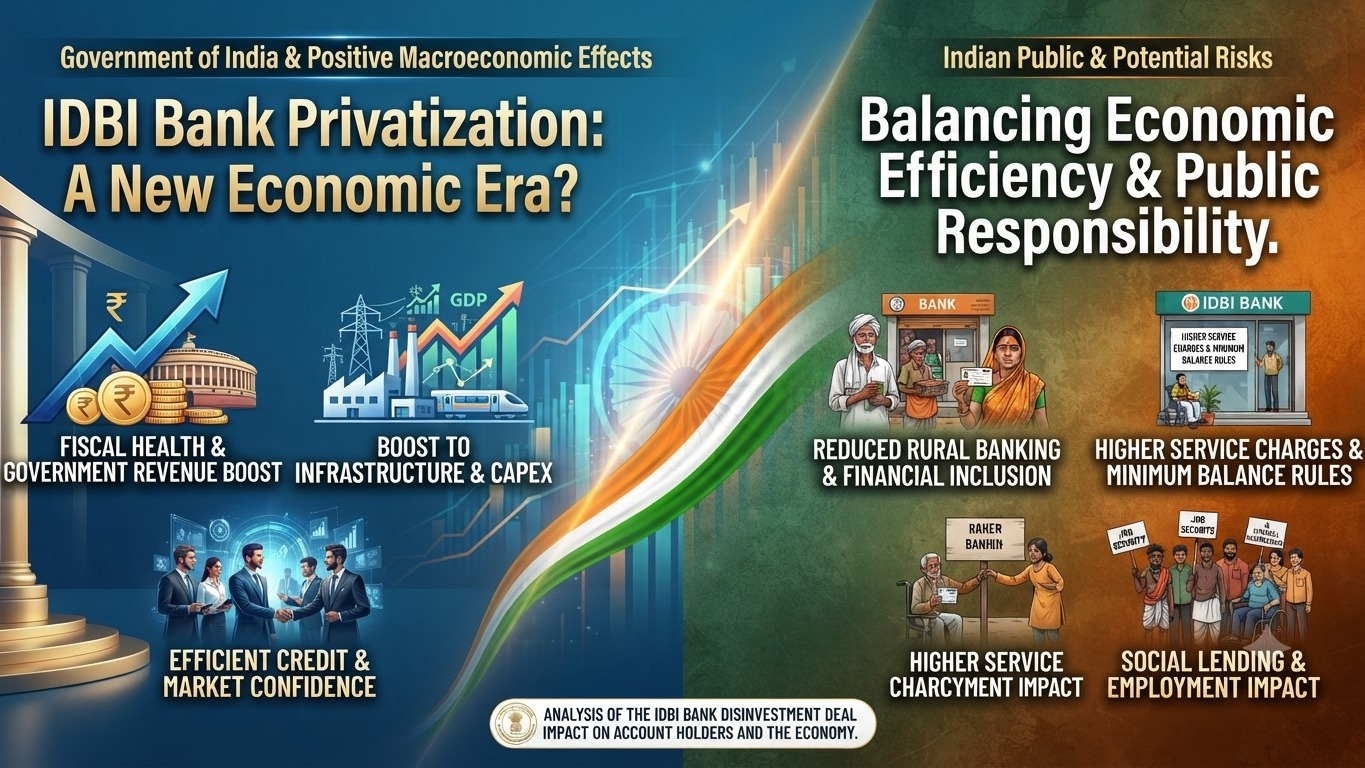
Higher Minimum Balance & Service Charges: Private banks generally require higher Monthly Average Balances (MAB) and impose stricter penalty charges for non-maintenance, which can burden low- and middle-income account holders.
Potential Closure of Rural Branches: While public sector banks focus heavily on financial inclusion across rural areas, private banks operate primarily for profit, which may lead to the downsizing or closure of unprofitable rural and semi-urban branches.
Reduced Focus on Government Schemes: Getting access to government-subsidized loans, social welfare hand-outs, or welfare schemes (such as Jan Dhan accounts or low-cost insurance plans) is often easier through public sector banks than private ones.
Impact on Employment & Reservations: Privatization raises concerns among bank employees regarding job security and career growth. Additionally, affirmative action and reservation benefits (for SC, ST, OBC, and affirmative quotas) in recruitment do not apply to the private sector.
Safety of Deposits
Are retail deposits safe? Yes. All commercial banks in India—whether public or private—are strictly regulated by the Reserve Bank of India (RBI). Under the Deposit Insurance and Credit Guarantee Corporation (DICGC) guidelines, deposits (including savings accounts and fixed deposits) up to ₹5 Lakh per depositor are fully insured and safe.
What could be the impact on the Indian Economy in the future?
The privatization of IDBI Bank and the reduction of the government's stake will have significant long-term macroeconomic effects on the Indian economy.
1. Positive Macroeconomic Impacts
Fiscal Deficit Reduction & Government Revenue: Selling its majority stake allows the government to raise substantial capital (disinvestment revenue). This directly helps narrow the country's fiscal deficit and keeps public debt levels under control.
Boost to Infrastructure & Capital Expenditure (CapEx): Instead of continually pouring taxpayers' money into bank recapitalization to cover bad loans, the government can redirect these funds into high-multiplier economic areas like highways, railways, renewable energy, healthcare, and education.
Increased Foreign Direct Investment (FDI): Allowing global institutional investors or foreign funds to acquire a major stake boosts international confidence in India's banking sector. It signals financial market maturity and opens doors for higher capital inflows into the country.
Improved Credit Efficiency & Corporate Growth: Under private corporate governance, the bank's non-performing assets (NPAs) are expected to decline. Faster and more efficient credit deployment will allow Indian businesses, startups, and industries to access growth capital more effectively.
Benchmark for Banking Sector Reforms: A successful divestment serves as a blueprint for future public sector enterprise (PSE) reforms. It helps modernize India's financial ecosystem, shifting public policy from government ownership to regulatory supervision.
2. Potential Risks and Challenges
Shift from Priority Sector & Social Lending: Public sector banks heavily drive subsidized credit to agriculture, small businesses (MSMEs), and low-income groups. A purely profit-driven private management model might shift primary focus toward lucrative retail and corporate lending.
Slowdown in Rural Financial Inclusion: Private capital prioritizes profitability, which could slow down the expansion of banking infrastructure in low-density or economically weaker rural and semi-urban belts.
Concentration of Banking Assets: As privatization proceeds across state-owned assets, a larger share of the banking system comes under private control. This requires tighter regulatory vigilance from the Reserve Bank of India (RBI) to prevent systemic risks and market concentration.
Summary
At a macro level, privatizing IDBI Bank improves fiscal health, asset efficiency, and capital allocation across the Indian economy. The long-term success of this move will depend on how effectively the RBI enforces lending norms to ensure that social inclusion, rural credit, and small business support remain uncompromised.
What does Reserve Bank of India (RBI) say about this? Has RBI agreed?
The Reserve Bank of India (RBI) has approved and agreed to the privatization of IDBI Bank.
Here is the current status of RBI's involvement and approval in the deal:
"Fit and Proper" Clearance: RBI evaluated the potential bidders and granted "Fit and Proper" clearance to shortlisted financial institutions. This assessment ensures that prospective buyers have sound financial health, clean operational track records, and valid banking governance capabilities.
Cabinet and Strategic Approval: Following initial RBI clearances, the Union Cabinet approved the transfer of management control along with the sale of a 60.72% majority stake (combining the holdings of the Government of India and LIC).
Final Regulatory Oversight: Since this involves transferring control of a major bank to a new entity, RBI retains full oversight over the final ownership structure, board appointments, and compliance guidelines before the deal closes.
In short, RBI has given its green light and is actively facilitating the deal, while ensuring all regulatory, risk-management, and depositor-protection norms are met.
Related Articles
SBI Dark Web Data Leak: Incident Overview, Exposed Data, and Security Measures
Is your State Bank of India account at risk? Find out what records were leaked on the dark web and essential security guidelines to protect your money.
Read More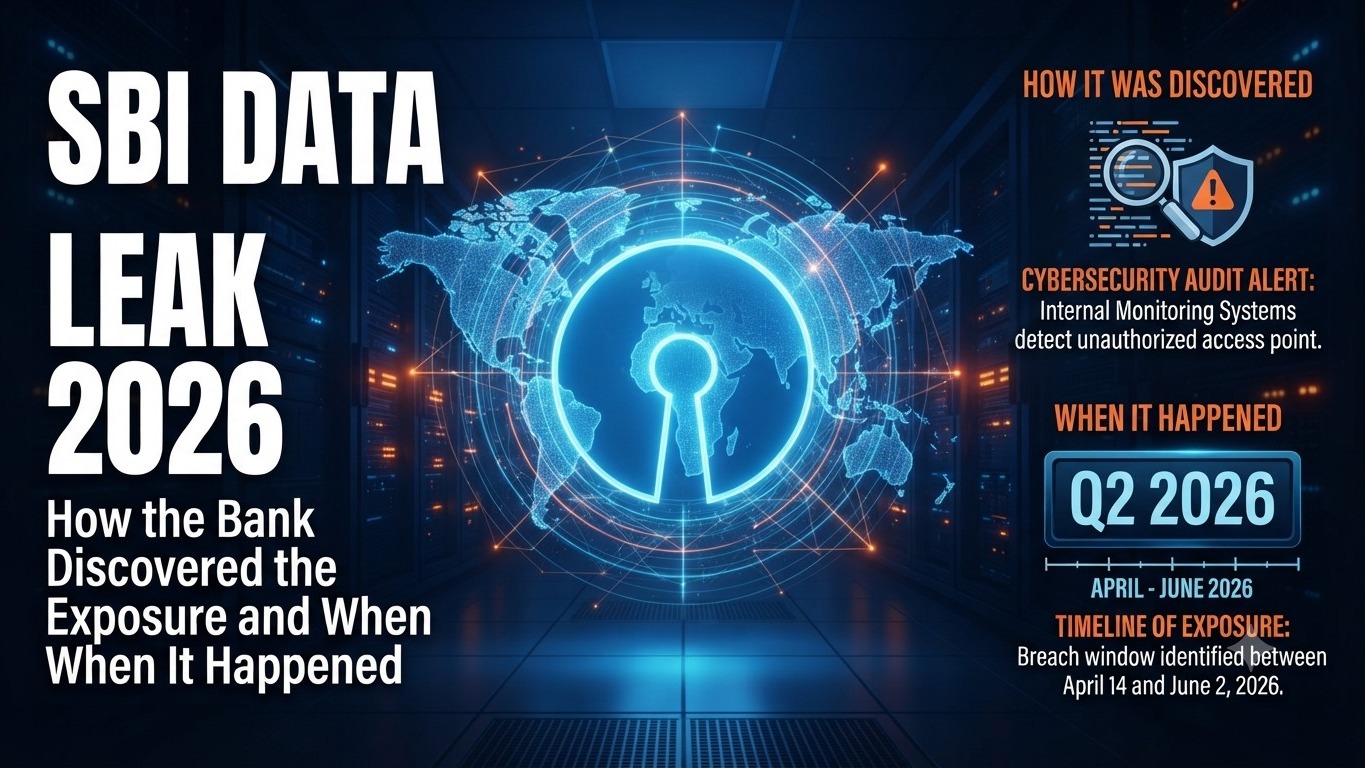
Is Your SBI Account Safe? What You Need to Know About the Recent Data Exposure
SBI reported a suspected data leak involving 3,897 customer records. Discover when the bank was alerted, how the exposure was detected and what customers should know.
Read More
Will the Ukraine War End Soon? Putin Agrees to Resume Talks with Kyiv and Washington, Claims Kremlin
Will the Ukraine war end soon? The Kremlin claims Putin agrees to resume talks with Kyiv and Washington amid hopes for peace.
Read More