
Is Your SBI Account Safe? What You Need to Know About the Recent Data Exposure
The State Bank of India (SBI), India's largest public-sector bank, is investigating a suspected data leak after customer-related information reportedly surfaced on the dark web. In a disclosure dated October 21, 2026, the bank said its preliminary examination identified 3,897 customer records containing personally identifiable information among approximately 375,000 records found online.
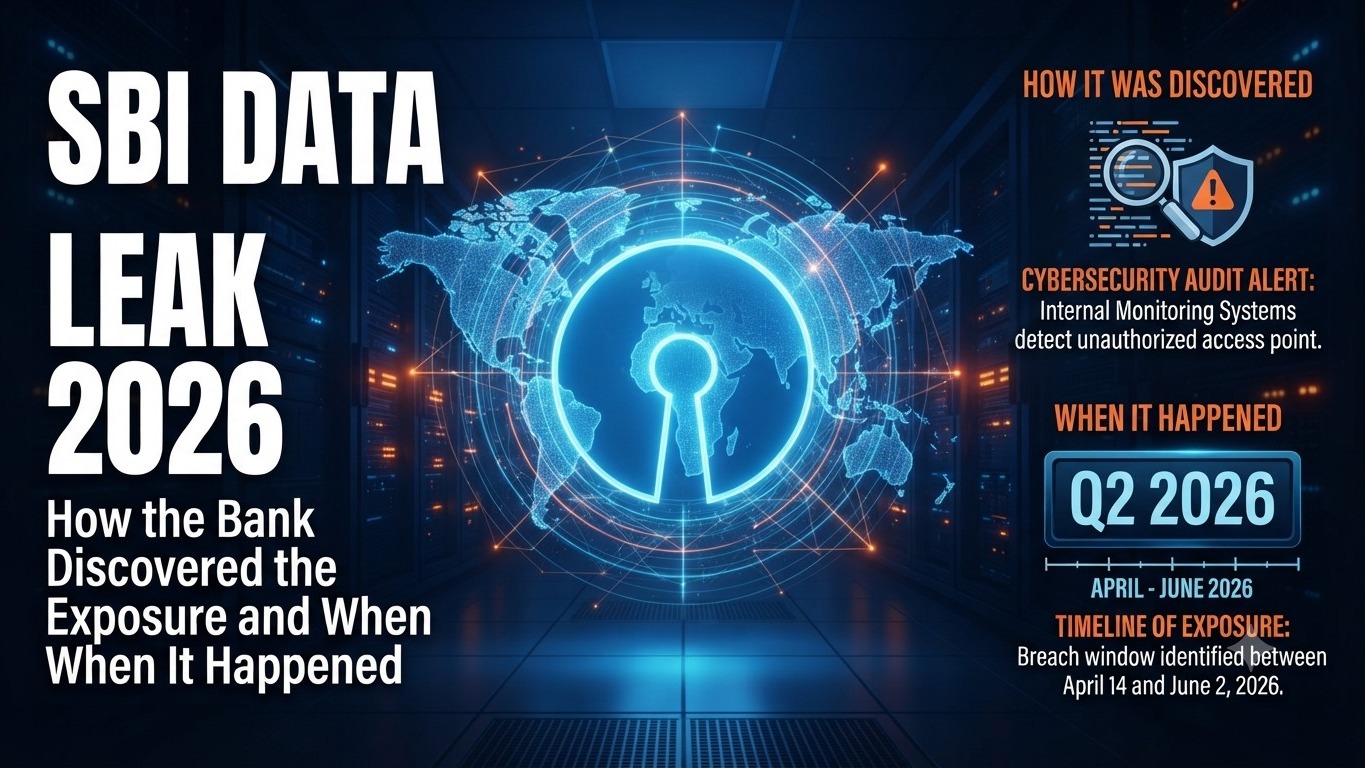
One important question has emerged: How did SBI discover the incident, and when did the bank first learn about the suspected exposure?
According to the bank's disclosure, SBI received alerts from three external sources on October 16, 2026. The bank subsequently initiated its incident-response procedures and appointed an independent cybersecurity agency to investigate the matter.
When Did SBI Discover the Suspected Data Leak?
SBI reportedly learned about the suspected exposure on October 16, 2026, after receiving communications from its threat-intelligence service provider, the Defence Cyber Agency and the Indian Computer Emergency Response Team (CERT-In).
The bank disclosed the incident to the Bombay Stock Exchange (BSE) and the National Stock Exchange (NSE) on October 21, 2026.
This means there was a five-day gap between the date SBI received the alerts and the public disclosure.
However, October 16 should not be mistaken for the date on which the data was originally stolen or exposed. The bank has not publicly established when the information first left its original source or how it became available online.
How Did SBI Find Out About the Data Exposure?
1. Alert from a Threat-Intelligence Provider
Threat-intelligence services monitor cybersecurity threats, including information that may be advertised, traded or circulated on underground online forums.
In SBI's case, its threat-intelligence service provider was one of the sources that alerted the bank to the suspected exposure of customer data.
Such monitoring can help organisations identify risks that may not immediately trigger conventional security alerts within their own networks.
However, SBI has not publicly explained the precise detection method used by its provider in this incident.
2. Alert from the Defence Cyber Agency
The Defence Cyber Agency was another source that reportedly informed SBI about the suspected exposure.
The agency operates in India's defence cybersecurity environment. Its communication formed part of the information that prompted SBI to investigate the matter.
The available public information does not establish whether the agency independently discovered the original source of the data or received information through another monitoring channel.
3. Alert from CERT-In
The Indian Computer Emergency Response Team, commonly known as CERT-In, was the third source identified in SBI's disclosure.
CERT-In is India's national agency responsible for coordinating responses to cybersecurity incidents. Alerts from such an agency can help organisations investigate suspected threats and take appropriate protective measures.
The three alerts prompted SBI to examine the records and assess the possible impact on its customers.
How Much SBI Customer Data Was Found Online?
According to reports about SBI's stock-exchange disclosure, the bank's preliminary analysis examined approximately 375,000 records available on the dark web.
Of these, 3,897 records were identified as containing personally identifiable information belonging to SBI customers.
The reported information included:
Customers' names and gender
Registered mobile numbers
Dates of birth
Email addresses
Residential addresses
Branch and Customer Information File (CIF) identifiers
Lead IDs and metadata associated with loan and lead records
The distinction between the two figures is important. The approximately 375,000 figure refers to the larger dataset examined, while 3,897 refers to the customer records containing personal information identified in SBI's preliminary analysis.
The bank has not yet publicly established the authenticity and completeness of the entire dataset or explained what all the remaining records contain.
Does SBI Know Who Was Responsible?
As of October 23, 2026, the publicly available reports cited here do not establish the source of the suspected exposure or identify a confirmed perpetrator.
SBI has engaged an independent cybersecurity agency empanelled by CERT-In to investigate the incident.
The investigation is intended to establish the authenticity and completeness of the exposed information, determine its possible source and extent, and assess the risks to the bank and its customers.
Until the investigation provides clearer findings, it would be premature to conclude that a particular hacker, employee, vendor or external organisation was responsible.
It is also important to distinguish between data appearing on the dark web and a fully established account-compromise incident. The former does not automatically prove that customers' bank balances or login credentials have been accessed.
Has SBI's Banking Service Been Affected?
SBI stated in its disclosure that the incident had no material impact on its core business operations, financial performance or business continuity.
The bank also said its core business functions continued to operate normally.
Nevertheless, the possible exposure of personal information creates risks that should not be ignored. Criminals may use leaked contact details to make fraudulent calls, send convincing phishing messages or impersonate bank officials.
For example, a caller who knows a customer's name, mobile number and loan-related information may sound more convincing than an ordinary scammer. Customers should therefore verify unexpected requests independently, even when the caller appears to know genuine personal details.
What Should SBI Customers Do to Stay Safe?
SBI customers can take the following precautions while the investigation continues.
1. Never share your OTP or PIN. SBI officials should not ask you to disclose your ATM PIN, UPI PIN, internet banking password or OTP over a call or message.
2. Be cautious about unexpected calls. If someone claims to be an SBI employee and refers to your personal or loan information, disconnect and contact the bank through an official channel.
3. Check your transactions regularly. Review your account activity and transaction alerts. Report any unauthorised transaction to SBI immediately.
4. Avoid suspicious links. Do not click on links in unexpected messages claiming that your account will be blocked or your KYC must be updated urgently.
5. Report suspected financial fraud quickly. In India, you can call the national cybercrime helpline at 1930 if you experience financial cyber fraud. You can also report the incident through the official National Cyber Crime Reporting Portal.
Customers should not panic or assume that every SBI account has been compromised. The bank's investigation is ongoing, and the published figures do not establish that all customers are affected.
Conclusion
SBI reportedly discovered the suspected data exposure after receiving alerts from its threat-intelligence provider, the Defence Cyber Agency and CERT-In on October 16, 2026. Five days later, on October 21, the bank disclosed the incident to the stock exchanges.
Its preliminary analysis identified 3,897 customer records containing personal information within a larger dataset of approximately 375,000 records found on the dark web.
The most important unanswered questions concern the origin of the data, how it became accessible and the full extent of the exposure. SBI has appointed an independent cybersecurity agency to investigate these issues.
For customers, the sensible response is to remain alert, protect banking credentials and report suspicious activity promptly. Further conclusions about the incident should depend on verified findings from the ongoing investigation.
Related Articles
SBI Dark Web Data Leak: Incident Overview, Exposed Data, and Security Measures
Is your State Bank of India account at risk? Find out what records were leaked on the dark web and essential security guidelines to protect your money.
Read More
Privatization of IDBI Bank: Impact on Account Holders & the Indian Economy
Is your money safe in IDBI Bank? Discover the pros, cons, and expert opinions on the government selling its stake in IDBI Bank and what it means for India.
Read More
Will the Ukraine War End Soon? Putin Agrees to Resume Talks with Kyiv and Washington, Claims Kremlin
Will the Ukraine war end soon? The Kremlin claims Putin agrees to resume talks with Kyiv and Washington amid hopes for peace.
Read More